English
Advanced 5-Axis CNC Solutions for Aerospace Materials
Writer:admin Time:2023-06-05 00:00 Browse:views
The aerospace industry demands precision, reliability, and performance above nearly all other sectors. Critical components such as engine housings, turbine blades, structural airframe parts, and flight control mechanisms must be machined from materials like titanium alloys, nickel superalloys, and high‑strength aluminum alloys — all while meeting strict tolerances (often in the sub‑millimeter or micron range) and stringent certification standards. To meet these demands, engineers increasingly turn to advanced 5‑axis CNC machining solutions that streamline complex part manufacturing and improve quality and consistency.
This article covers the technology, applications, performance data, benefits, tooling strategies, process workflows, inspection standards, and future trends associated with 5‑axis CNC machining for aerospace materials.
1. What Is 5‑Axis CNC Machining?
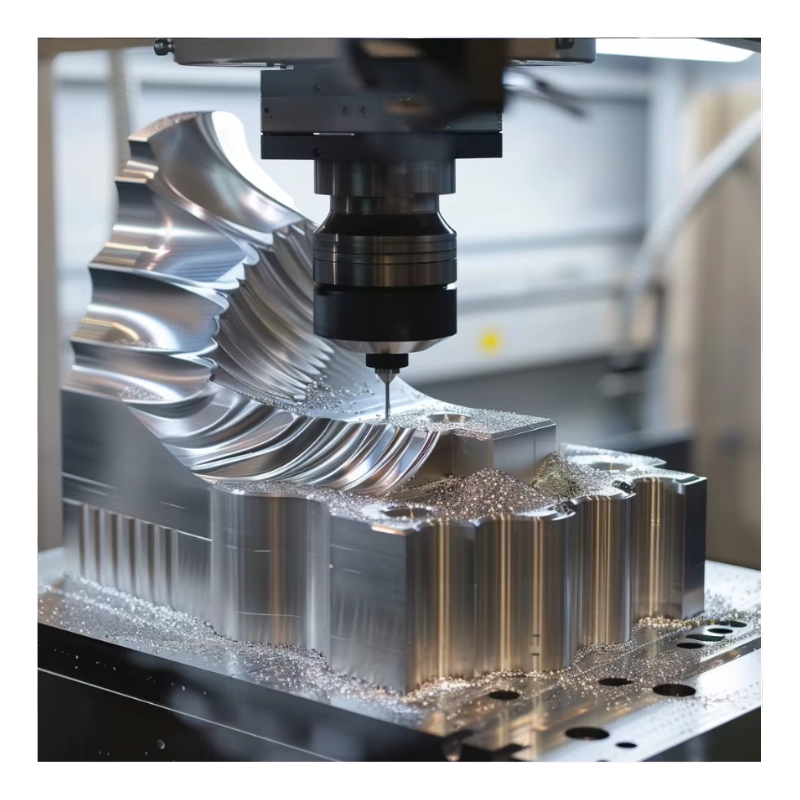
5‑axis CNC machining refers to a type of computer numerical control (CNC) machining where the cutting tool or the workpiece moves along five independent axes simultaneously: three linear (X, Y, Z) and two rotational (A and B or B and C). This additional flexibility allows the cutting tool to access features that are difficult or impossible to reach on traditional 3‑axis machinery.
In aerospace manufacturing, complex curved profiles, undercuts, deep cavities, and freeform geometries are nearly impossible to machine efficiently without 5‑axis technology. With 5‑axis machining, a single setup can often replace multiple setups required on 3‑axis machines, significantly reducing cumulative error and improving component quality. (CNCRUSH)
Table 1: CNC Axis Configurations and Capabilities
| Axis Configuration | Key Motion Axes | Typical Capabilities | Aerospace Examples |
|---|---|---|---|
| 3‑Axis CNC | X, Y, Z | Linear movements only | Simple housings, brackets |
| 4‑Axis CNC | X, Y, Z + A | One rotary axis added | Indexed features on cylindrical parts |
| 5‑Axis CNC | X, Y, Z + A + B (or C) | Full simultaneous multi‑direction cutting | Blisks, turbine blades, impellers |
| 5+ hybrid systems | Includes additional machining tools | Combines milling & turning, additive capabilities | Integrated workflows |
2. Aerospace Materials Machined with 5‑Axis CNC
Aerospace components are machined from a variety of specialized materials selected for strength, weight, corrosion resistance, and high‑temperature performance. 5‑axis CNC machining improves manufacturability and quality for these challenging alloys.
Table 2: Aerospace Materials & Machining Attributes
| Material | Typical Use | Machining Challenges | 5‑Axis CNC Benefit |
|---|---|---|---|
| Titanium Ti‑6Al‑4V | Airframe, engine fasteners | Low thermal conductivity, work hardening | Optimal tool angles reduce heat, deflection |
| Inconel 718 | Turbine housings, hot‑section parts | Severe work hardening, high shear strength | Single‑setup machining of complex surfaces |
| Aluminum 7075/6061 | Structural components | High speed machining, chatter | Precision high‑speed cuts, reduced setups |
| Carbon composites | Lightweight structures | Fiber pull‑out, delamination | Advanced toolpaths reduce damage |
Titanium and Inconel, in particular, are notoriously difficult to machine due to heat generation and tool wear. Advanced 5‑axis toolpaths optimize tool engagement and maintain chip load, helping extend tool life and preserve surface integrity.
3. Precision and Tolerance Standards
Precision is foundational in aerospace production. Many 5‑axis CNC providers (including those machining aerospace materials) routinely achieve tolerances on the order of ±0.002 mm on critical features and general tolerances of ±0.005–±0.01 mm for complex geometries using state‑of‑the‑art machines and control strategies. (Super-Ingenuity (SPI))
Table 3: Typical Tolerance & Surface Finish Metrics for Aerospace Parts
| Material / Feature | Typical Tolerance | Surface Finish (Ra) | Notes |
|---|---|---|---|
| Titanium Ti‑6Al‑4V | ±0.005 mm | ≤1.6 µm | Structural and load‑bearing parts |
| Inconel 718 | ±0.01 mm | ≤1.6 µm | Hot section components & fixtures |
| Aluminum Alloys | ±0.005 mm | ≤0.8 µm | Lightweight structural parts |
| Carbon composites | ±0.05 mm | ≤1.6 µm | Panel trimming and assembly surfaces |
Achieving these tolerances requires advanced CAM programming, optimized toolpaths, and integrated control systems that synchronize all five axes with minimal vibration and positional error.
4. Key Benefits of 5‑Axis CNC for Aerospace Manufacturing
Modern aerospace manufacturing uses 5‑axis CNC to realize advantages that significantly improve economics and performance.
4.1 Reduced Setups and Lead Time
Because 5‑axis machines can reach multiple surfaces in a single clamping, multiple setups (and associated repositioning errors) are eliminated. This often reduces lead times by 30–50% compared with traditional machining approaches. (okdor)
4.2 Enhanced Precision and Repeatability
A single setup means fewer opportunities for alignment deviation, enabling micron‑level repeatability across production runs and high first‑pass yield rates — essential for safety‑critical aerospace parts.
4.3 Superior Surface Quality
Optimal tool orientation facilitates consistent cutting conditions across complex surfaces, resulting in smoother finishes and fewer tool marks — beneficial for aerodynamic and fatigue‑sensitive parts. (CNCRUSH)
4.4 Greater Material Efficiency
By minimizing unnecessary tool interference and enabling constant tool engagement, 5‑axis machining optimizes material removal rates and reduces waste.
4.5 Increased Tool Life
By managing chip load and approach angles better than 3‑axis machines, tool wear is reduced — lowering tooling costs and downtime.
5. Tooling and Toolpath Strategies
Effective tooling and toolpaths are critical to exploit the full potential of 5‑axis machining.
5.1 Tool Types and Uses
| Tool Type | Best Application | Advantage |
|---|---|---|
| Ball End Mills | Freeform surface finish | Smooth contours |
| Bull / Radius End Mills | Roughing to semifinish | Balanced stiffness & cutting |
| Tapered Tools | Deep pockets & fillets | Reach with stiffness |
| High‑Performance Carbides | Heat & wear resistance | Extended tool life |
5.2 Advanced Toolpath Techniques
Constant scallop height: Ensures uniform surface finish.
Rest machining: Roughing leftover material efficiently.
Trochoidal toolpaths: Reduces heat and extends tool life when removing large volumes.
6. CNC Control Systems and CAM Software
Achieving precision and efficiency demands high‑end CNC control systems (e.g., FANUC, Siemens, Heidenhain) capable of handling simultaneous 5‑axis motion with real‑time synchronization and feedback. Advanced CAM software (like NX, Mastercam, or PowerMill) generates optimized toolpaths and integrates simulation to avoid collisions.
Table 4: 5‑Axis CNC Control & CAM Features
| Feature | Function | Benefit |
|---|---|---|
| Simultaneous axis interpolation | Coordinate multiple axes at once | Smooth tool motion |
| Collision detection | Predictive multi‑axis simulation | Protects parts & tooling |
| Adaptive feed control | Adjusts feeds/speeds based on load | Improves finish & tool life |
| Real‑time feedback | Axis position correction | Enhances accuracy |
| RTCP (Rotational Tool Center Point) | Tool orientation consistency | Maintains precision |
These features improve cycle times, reduce scrap, and enhance quality control.
7. Cost and Productivity Considerations
While 5‑axis CNC systems are a significant investment, they deliver strong productivity and cost advantages over time. Complex parts that would require multiple fixtures and machines on 3‑axis setups benefit greatly from reduced setups, fewer secondary operations, and improved part consistency.
Table 5: Productivity & Cost Savings with 5‑Axis CNC
| Productivity Metric | Typical Impact | Description |
|---|---|---|
| Setup reduction | Up to 80% fewer | Fewer fixture changes |
| Cycle time savings | 30–50% | Continuous correlated tool motion |
| Tool change frequency | Reduced | Optimized tool engagement |
| Material waste | Lower | Efficient removal strategies |
| Lead time | Shorter | Single‑setup machining |
These reductions contribute to lower overall manufacturing cost, particularly for low to moderate volume aerospace production.
8. Inspection and Quality Assurance
Aerospace parts often require traceable inspection and documentation, including CMM (Coordinate Measuring Machine) validation and GD&T reporting. In‑process probing is also used to dynamically adjust toolpaths and maintain precise dimensions.
Typical inspection instruments include:
CMM for dimensional accuracy
Surface profilometry for finish verification
Laser scanning for complex surface contours
Quality systems such as AS9100 and NADCAP certification help ensure aerospace‑grade production control and traceability.
9. Industry Applications
Aerospace Engine Components
5‑axis machining is used for turbine blades, vanes, compressor discs, and engine housings that feature curved, freeform geometries with tight tolerances. (CNCRUSH)
Structural Airframe Parts
Brackets, fittings, and load‑bearing connectors with complex mounting points benefit from single‑setup machining.
Landing Gear and Actuation Parts
High precision and durability demands mean parts like actuator housings and linkages are often 5‑axis machined.
Satellite and Spacecraft Components
Lightweight structural parts and brackets with high accuracy requirements rely on multi‑axis machining.
10. Challenges and Best Practices
While 5‑axis CNC is powerful, its implementation requires:
Experienced CAM programmers
Robust machine calibration
Thermal compensation strategies
Adaptive tooling strategies
Best practices include early DFM (Design for Manufacturing) review, collaborative engineering to simplify fixturing, and leveraging simulation to minimize trial‑and‑error.
For practical insights and advanced machining strategies tailored to aerospace applications — including tooling choices, process optimization, and hybrid solutions — many engineers refer to resource hubs such as https://www.eadetech.com for real‑world workflow examples and technical guidance.
11. Future Trends in 5‑Axis Aerospace Machining
The future of aerospace machining includes:
AI‑assisted CAM path optimization
Sensor‑enhanced adaptive control
Hybrid additive‑subtractive workflows
IoT‑linked smart machining centers
Energy‑efficient machine designs
These trends will further increase precision, reduce cycle times, and lower total ownership costs.
Conclusion
Advanced 5‑axis CNC machining solutions have revolutionized how aerospace materials are processed — enabling manufacturers to produce complex parts with micron‑level accuracy, superior surface finish, and reduced lead times. From titanium alloy airframe components to Inconel hot‑section engine parts, this technology supports the demanding requirements of modern aerospace engineering.
By optimizing toolpaths, enabling single‑setup machining, and integrating advanced control systems, 5‑axis CNC machines deliver performance that traditional methods simply cannot match. For additional technical insights, tooling strategies, and process optimization examples tailored to aerospace materials, sites like https://www.eadetech.com offer practical case studies and machining solutions.
Related Article


CATEGORIES
LATEST NEWS
CONTACT US
Whatsapp: +8618998453346
Phone: +8618998453346
Tel: +8618998453346
Email: [email protected]
Addr: Room 302, Building D, COFCO Gonghua Project, Zone 20, Honglang Community, Xin'an Street, Bao'an District, Shenzhen City.